

The Comrades in Arms team are delighted to announced their 2nd anniversary game to be held at First and Only's Bolton woodland site on the 14th December 2008.
'Unternehmen Herbstnebel' (Operation Autumn Mist) will be revisiting our very first game - the German offensive dubbed by the Americans as the Battle of the Ardennes but known to everyone as the Battle of the Bulge.
Bolton is an exciting and interesting woodland site well suited for the battle and just at the right time of year of course!
Full details will be posted in the coming days with regard to numbers, booking, catering, accommodation etc. so please, no need to ask, all information will be provided.
Oh, and there will be a nice surprise for card-carrying Comrades in Arms members as a thank you for your support this past couple of years. 


The cost for this game is £30 and includes lunch and tea/coffee on Sunday.
Full information on how to book can be found here:
viewtopic.php?f=91&t=5541
While fearsome battles for Bastogne still rage and St Vith now in German hands our game moves us from our 2006 scenario towards Christmas and into the New Year up on the Northern edge of the ‘Bulge’.
The German imperative (if they were to achieve their goal of cutting through American and British lines to extend routes to Antwerp) was to cross the River Meuse. With Montgomery in charge of the 21st Army Group the Northern front was his to command. Critical to blocking a German push was holding the river that formed a natural barrier. XXX Corp held the bridges secure from Givet, Dinant, Huy, Liege to Namur with yet more British and US divisions moving behind the lines to form a solid defence.
The German 6th Panzer Army had pushed through from East to West, divisions taking Malmady and pushing against Trois Ponts en route to their planned breaching of the Meuse.
Our game takes us to a small area between the towns of Hotton, La Roche and Manhay where fierce battles were fought as the XLVII, LVIII and IISS Pz Corps pushed against the US 2nd Armoured and reinforcing British 1st Division.
The British 29th Armoured Brigade, SAS and 2d Household Cavalry Regiment reconnaissance patrols made themselves busy while the German 5th Panzer Army split itself looking North to the Meuse and South to Bastogne. The 1st 2nd 9th and 12th SS Panzer Divisions, Panzer Lehr, 2nd 9th 10th and 116th Panzer Divisions and 560th Volks Grenadier Division were attempting a pile driver blow northwards to the river faced by the US 84th Division,75th Infantry Division, 2nd, 3rd, 7th and 9th Armored Divisions, 4th & 24th Cavalry Regiment and 82nd Airborne.
With supply lines poor, fuel running low and formations broken up, can the Germans break through to the Meuse? Or will Monty make up for Caen and Arnhem criticisms? Allied communications are often poor and commanders have divisions running helter-skelter, stopping up gaps and second-guessing their counterpart German commander’s plans. Towns fall and are recaptured, critical crossroads become the focus for closely fought battles, fuel dumps become all-important, speed and surprise often the only way to make progress…
The British operations
Field Marshal Montgomery, headquartered at Zonhoven, Holland busied himself with holding the front line with thinly stretched British and Canadian divisions. His XXX Cops was refitting and resting further back pending it’s planned January attack on Germany.
Word came through of a surprise enemy breakthrough in the Ardennes. Could this be the work of the ‘missing’ German 6th Panzer Army?
Without orders from Supreme Command Monty placed his 43rd Infantry and Guards Armoured divisions on standby, ready to move to the South. Realising that the natural barrier of the River Meuse was also vulnerable to attack he prepared three divisions, some 50,000 men, and moved them to the river, followed by two more infantry divisions and two armoured divisions.
Monty was ready for business!
Frustrated that he hadn’t been given any battle orders and was only being told of what the embattled American forces were up to, Monty had made it known that he wished to take control of the Northern group now that German forces were splitting Allied forces and North/South communications were getting difficult. The failure of General Hodges to get a grip had brought the situation to a head.
At last Eisenhower realised the logic of Monty’s request and the unthinkable happened - the US 1st and 9th Armies were put under British Command.
Already Monty was at work. His intention was to hold back XXX Corp back as far as possible (so that they were still able to put the planned attack on Germany front lines in early 1945) and made as much use of US forces as he could. Still, coming up to defend the river and it’s crossing were 3rd Royal Tanks, 23rd Hussars, 2nd Fife & Forfar, 8th Battalion Rifle Brigade. 2nd line troops were mobilised - men who hadn’t fired a rifle for years were handed weapons. British and Belgian SAS were rushed from France. A secret sapper unit codenamed ‘R-Engineers’ were ordered to prepare for bridge blowing. An anti-tank regiment heading back for England was turned back. The Red Devils of 6th Airborne Division were despatched from England, Christmas leave cancelled.
2nd Household Cavalry were by now patrolling ten miles deep on the ‘German’ side of the Meuse followed later by the 29th Armoured Brigade. The 3rd Royal Tank Regiment pushed out from their defence of the Dinant bridge into the unknown. By Christmas the German 2nd Army had a line stretching from St Vith in the East to Foy-Notre-Dame in the West with units probing towards the Meuse looking for a breakthrough. 9th Panzer held Humain but surrendered under pressure from the Crocodiles of the 2nd Fife and Forfar Yeomanry. 3rd Royal Tank and 23rd Hussars pressed forward along with the 53rd Welsh Division (who were followed by the 51st Highlanders).
British and German forces were now meeting head to head in atrocious weather conditions….
British forces will be represented by Oxf and Bucks Light Infantry, the 1st Battalion which were part of the 53rd Welsh Infantry Division and the 2nd Battalion which were part of the 6th Airborne Division. There will also be roles for sappers and SAS reconnaissance.

 Black Watch meeting up with Yanks at La Roch
The German operations
For three nights 47th Panzer Corps had been moving toward the River Our - travelling at a rate of five kilometres per hour under the cover of darkness. Tank tracks covered, horses hooves wrapped in cut up blankets, infantry marching on straw covered roads.
600,000 German troops divided into three armies waited on the 60 mile long front line poised to attack. Opposite them were four weak American divisions - two green and two battered from previous weeks fighting, here to rest and regroup. Just 60,000 men facing the cream of the Wehrmacht.
At 0530hrs on 16th December 1944 2.000 canons opened up a huge artillery barrage. American forces billeted in towns and villages were rudely awakened. US communications had been cut by shelling and sabotage. Half an hour later 8,000 troops of 26th Volks Grenadier division moved out of the woods.
Over the ensuing few days the German forces swept all before them, they had the initiative. Marnach and Clervaux were taken and the road to Bastogne was open. Hitler’s plan was to cross the River Meuse south of Liège and then drive for Antwerp, splitting the allied forces and negotiate a favourable peace rather than an unconditional surrender. However, his Generals on the ground favoured crossing the Meuse and swinging north-east to link with the German attack from Holland. This way ten to twelve divisions would be cut off and have the same political effect. Regardless, both plans required crossing the Meuse.
On and even before 16th December eight ‘jeep teams’ had move out. Dressed in US uniforms and carrying American weapons their task was to sabotage, spy and kill prominent American personnel. One team of Skorzeny’s men rapidly reached as far as the Meuse bridge at Huy. Just after dark they observed the bridge. It was lightly guarded, no flak or anti-tank canon. They reported back to headquarters that the bridge was there for the taking.
Elsewhere another jeep team had been stopped by a suspicious MP having failed to give a password. A search of the jeep found $100 bills, Stens, radio transmitter, grenades and a real giveaway - zippo lighters secretly containing suicide pills. It could be said that Skorzenys’ Operation Griffin was a dismal failure - except that from that point on rumours and suspicions spread like wildfire amongst the Allies and caused no end of disruption. Even Montgomery had to ask Eisenhower for US ID documents as he was stopped so often.
While the 5th panzer Army headed for Bastogne further north Dietrich’s 6th Panzer Army (comprising 1st SS Pz div - Liebstandarte Adolf Hitler, 12th SS Pz Div - Hitlerjugend, 2nd SS Pz Div - Das Reich, 9th SS Pz Div - Hohenstaufen as well as Heer infantry and armoured divisions) drove westwards taking in Malmady, Stavelot, Trois Ponts, Manhay, La Roche, Marche, Rochefort, and Foy-Notre Dame, just a few miles from the Meuse river crossing at Dinant.
Throughout, key targets were US fuel dumps as the Germans were desperately short. Speed of assault was vital as delays would allow Allies to reinforce and block routes through to the Meuse. Weather conditions didn’t help as tanks had to be kept to roads if at all possible making occupation of crossroads and towns a key to progress. It is this northern route from the river Salm in the east, crossing the Ourthe then to the Meuse in the west that would be crucial to carrying through the objective.
German forces will be represented by 9th SS Pz. Div (Hohenstaufen) and 116th Pz Div
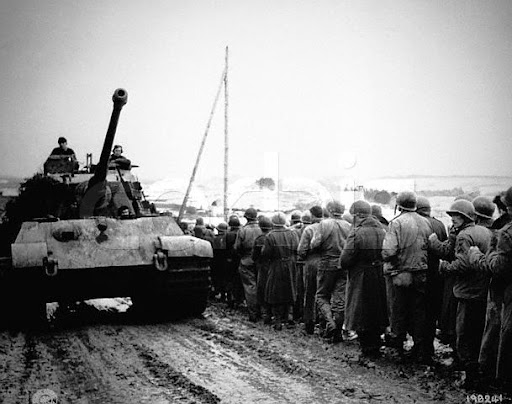

The US operations
At 0530hrs on 16th December 1944 a young sentry on top of a water tower at Hosingen was startled by pinpoints of light everywhere down below on the river Our. For a second or two has was a t a loss to explain this. They grew and spread the suddenly the sentry’s ears were deafened by the thunder of a huge artillery barrage. After three months of peace and inactivity the war had returned to the ‘Ghost Front’.
At Clervaux officers hurriedly pulled on uniforms and made for their operations room. Frantically they tried to make phone calls to Divisional Headquarters to no avail - all lines had been cut by the barrage or sabotage. The front was cut off from the rear.
Around 0700hrs General Hodges, commander of US 1st Army was preparing for a bacon and eggs breakfast. Before he could take up his cutlery an aide passed him an urgent message. The commander of 28th Inf Div in the south was reporting the heaviest fire ever received in that area. Elsewhere 99th and 106th divisions were sending garbled signals that they were coming under fire and being attacked by German infantry. A little later on his 4th If Div at the far end of the Ardennes front reported enemy attacks.
One might have thought alarm bells would be ringing. The whole 60 miles front from one end to the other was being assaulted. Hodges had a reputation for being indecisive and ordered two major units to stand by. He ordered the 1st Army’s previously planned drive north to continue, in preparation to assault the Roer dam, despite 2nd Inf div’s pleas to call it off. Hodges thought the German front line penetrations were just a diversionary tactic. And with that Hodges turned to the more important matter of a fitting session for his new expensive Belgian shotgun.
Eisenhower, Allied Supreme Commander, was at his Versailles headquarters. He had just received a top priority letter form Montgomery asking for Christmas leave in England, which he authorised. He and some of his staff went to a colleague’s wedding and later gave a reception at his house at Saint-Germain. Later he played poker with the 12th Army Group commander. As the light faded their ‘conference’ was interrupted by a report of German attacks in the Ardennes. They carried on with the game.
Patton meanwhile had been watching the reports with interest. He instructed his 3rd Army to pull out of it’s planned attack into the Saar and turned 90 degrees towards Luxembourg. Montgomery was given the news of something happening on the 1st Army’s front while he was playing golf at Eindhoven. He immediately flew back to his Zonhoven headquarters. Even though he had no idea of enemy intentions or Eisenhower’s reactions he decided, with orders, to put in place preliminary actions.
The following day General Bradley, commander of the 12th Army Group reached his Luxembourg headquarters - he had been absent and unable to make any decisions for twenty three hours. He studied a wall map, heavily marked showing enemy thrusts. He was amazed the Germans had committed fourteen divisions already. Still not convinced it was an all out enemy attack he asked Eisenhower to part with his last reserves - the veteran 82nd and 101st Airborn Divisions. The 101st were to go to Bastogne and the 82nd to head north to the area of Spa to stop the advance of the 6th SS Panzer Army.
By the third day Hodges has realised the situation was deteriorating rapidly. Outside his headquarters at Spa was in chaos with clogged roads as jeeps, trucks and cars prepared for the big bugout’ - his front was falling apart.
With German divisions sweeping west towards the Meuse and southwest towards Bastogne the situation was critical. Patton planned a three division attack, Montgomery took over Hodges’ 1st Army as well as the 9th Army and defence of the Meuse and attacks on beleaguered towns and villages put in place.
St Vith was under severe pressure and Monty decided to pull troops out, much to the US astonishment, as part of his ‘tidying’ of battle lines. 82nd Airborne, sent to relieve St Vith, were now pulled eastwards towards the March area - veteran troops being saved for attacking roles rather than defensive. Now, as the 6th SS Panzer Army extended towards Dinant, the US and British forces held the land between the German finger’ and the River Meuse.
It was vital the River Meuse was held secure. British defence was robust and US reinforcements were coming at last. But was it enough? Would the feared elite 6th SS Pz army force through the separated allied armies?
American forces will be represented by the 82rd Airborne, 84th Infantry Division and the 2nd Armoured Division


Looks like Guy has reached the River Meuse Bridge at Huy already - game over!
Please be sure you bring your mess tins, cutlery and esbits/hexis with you - we will be eating in the battle zone for this game. Hot food (corned beef hash or something similar will be provided, veggie option too).
Don't forget those e-tools! They will useful for improving your defensive positions, clearing flooded trenches and gun emplacements...
It's a peach of a site , easy to get lost in the woods though . E tools will be very useful , and make sure you carry a canteen and fork , food served in the field will be a treat but only if you can collect and eat it !
Snow cammo ...er yers may need it by December with some fingers crossed.
We haven't mentioned the Saturday night camping yet either ..... 