

Uniform Guide for US Infantry Unit
Footwear
* "Roughouts" - These are the combat shoes that followed the Garrison Shoes. They have the rough side of the leather on the outside, like suede or unfinished leather. These would likely have had dubbing or "shoe impregnite" (poison gas barrier) thoroughly rubbed into them, looking more like used work boots than pretty suede shoes.
* Double-buckle boots - These came later in the war. These are good for post-Normandy combat events and displays, and will save you the trouble of using the leggings.
* Leggings - M1938 Dismounted Canvas Leggings in khaki. These are used with either the garrison shoes or roughouts mentioned above.
* Socks - OD wool or cotton socks.
* Bootlaces - Brown and flat. There are a number of suppliers that carry original or original-style WW2 laces.
Headgear
* M1 Helmet - including the shell, liner, webbing/chinstraps and netting. Shell can be post-war (seam in back) if the chinstrap is converted to WW2 khaki webbing. Liner should be WW2, but post-war liners are acceptable for airsoft if they are converted to WW2 leather chinstraps. Helmets and liners should be painted the correct WW2 color.
* Overseas Cap - Must have light blue infantry piping. If you wish to portray Engineers or other units, look up the appropriate colored piping for that unit.
* Jeep Cap - Knitted cap with a small brim sewn in. We have seen these vary in color from mustard to forest green. At cold weather tacticals you will want one of these under your helmet.
Trousers
* OD Wool Trousers - M1936 Mustards
* HBT Trousers - some units at D-Day (such as the 299th Combat Engineers) wore these over their wools.
* Belt - Web belt with open-face buckle.
Shirts
* OD Wool Shirt - to match the trousers - Enlisted Man's version. Gas flaps on the inside are optional, but gas-flap versions are good for D-Day. (Actually, a lot of times the gas flaps were ripped out of these shirts as most GI's found them useless and a nuisance.)
* HBT Shirt - Optional; may be worn over wool shirt by some units we portray on D-Day (see HBT Trousers listing above).
* T-Shirts, A-Shirts, etc. for underneath the wools or HBT's.
Field Jackets
* M41 Field Jacket - look for dark tan buttons if possible, or check WWII Impressions for replacement buttons. There are numerous suppliers of these out there; some are better than others.
* "Tanker" Jacket - optional, or a substitute for the M41.
* M43 Field Jacket - optional, but NOT a substitute for the M41 or tanker. If you don't have a tanker jacket, you'll wish you had an M43 to wear over your M41 at a cold weather tactical. Repros are fine, but the Norwegian field jacket from the late 1960's is close to the US WW2 M43.
Insignia
Ranks to be determined by the doughboys, most members of a US Rifleman squad would have been lead by a staff sergeant, maybe 1 or 2 sergeants, handful of corporals and the rest Privates
Weapons
* The M1 Garand.
Note: Many rifle squads retained at least one '03 Springfield amongst them to use as a grenade launcher, as the Garand grenade launcher was slow to be adopted.
* M1 Carbine - If you are planning to be an assistant to one of our machine gunners, or just like the smaller size this is for you, good luck getting your hands on 1 though!
* Colt .45 1911 Pistol - Optional, if you choose to carry one where your role would require or allow one. All officers and most NCOs carried a .45, not many of the Riflemen carried them.
* Bayonet - with scabbard, and appropriate to whichever rifle you are using.
With the Garand you may use one of the following:
o M1 (10" blade)
o M1905E1 (10" blade cut down from the 16" M1905)
o M1905 (16" blade) - either WWI or WWII (not recommended as
* Knife (optional) - M3 fighting knife in M8 scabbard.
Web Gear & Equipment
Note: All web gear listed is to be khaki unless otherwise noted. - Green webbing was issued towards the middle to end of the war, so it can be used (just depended on what colour dye the manufacturers were using at the time)
* Haversack - M1928, with meat can pouch. Pack tail ("diaper") is not needed. Optional: M1910 Haversack.
* Ammo Belt - specific to the rifle you're carrying; M1923 10-pouch cartridge belt for Garand or Springfield
* 1st Aid Pouch - Carlisle type on belt, with Carlisle bandage inside.
* Canteen/Cup/Cover - M1942 (WW2 style) Aluminum or stainless steel canteen with correct cap, cork, and chain; aluminum or stainless steel cup
(In airsoft this pouch is handy for carrying a speed loader or blanks for BFG)
(optional: M1910 WW1 style); Infantry (regular) style khaki cover that hangs on ammo/pistol belt.
* Entrenching Tool with khaki cover - one of the following:
o M1910 T-handle shovel
o M1910 Pick Mattock
o M1910 Hand Axe
o M1943 Folding shovel (appropriate for D-Day and later)
* Pistol Belt - optional, recommended (or required depending on role).
* Suspenders - M1936, optional, recommended
* Musette Bag - optional, recommended (or required depending on role) - Usuaully issued to Airborne to be hooked onto the suspenders.
If you are going to get the doughboy pack, you do not need the M1936 suspenders, as it comes with built in straps.
Most of the above text I have edited, based on minimum kit requirements for the 3rd Squad Re-enactors.

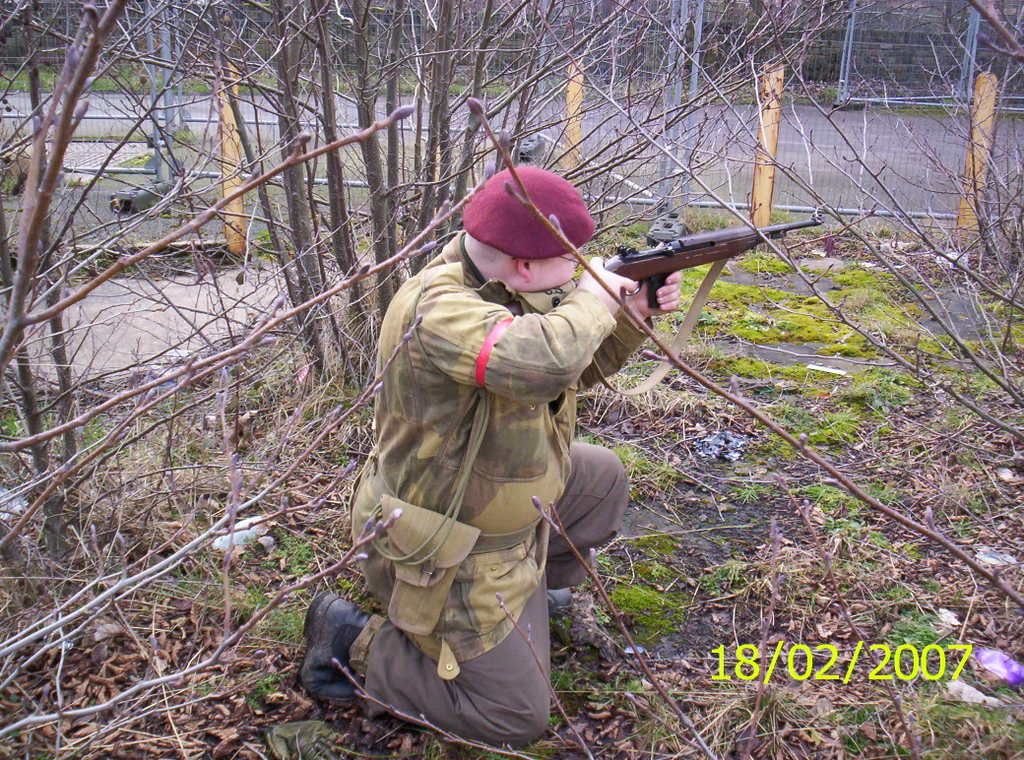
What was the ammount of ammo typically carried ready to go by the Section? And a breakdown if you can manadge one Matt.


You mean the whole section or the individual soldier?
A Rifleman with a Garand would have been carrying between 9x8 rounds (in cartridge belt) multiples of 6x8 in Bandoliers and I'm sure that a person carrying an ammo bag would have them stuffed with garand clips, frag grenades and TNT.... so thats what... between 72 rounds and 168+ rounds.
Carbine soldiers, using 15 round clips, probably carrying between 5-7 mags depending on how many they could get their hands on, plus maybe a 45 with 16 rounds
Thompson SMGunners, 20 or 30 round clips, probably between 5-10 mags in various pouches, so could be beteen 150-200 rounds.
BAR gunners, 12x 20 round mags, plus I would imagine a few more mags in lose webbing/bags... possibly 240+ rounds
Infantry squads would have been made up of a handful of Riflemen, a few NCOs with Thompsons, 1 or 2 support gunners and Head NCO or Officer for PLatoon level.
Firepower of any particular squads, you're looking at being able to put down a few thousand rounds in the space of a few minutes 
Yeah something like that mate. Is that a guess or is it from an official source?
Educated Guess, based on amount of ammunition carried by each solider in turn based loosely around the makeup of the webbing.
Squad strength would entirely depend on re-enforcements etc... a lot of the US soldiers got wooped in the Bocage country after going inland from Normandy, so Squads weren't always at full strength.